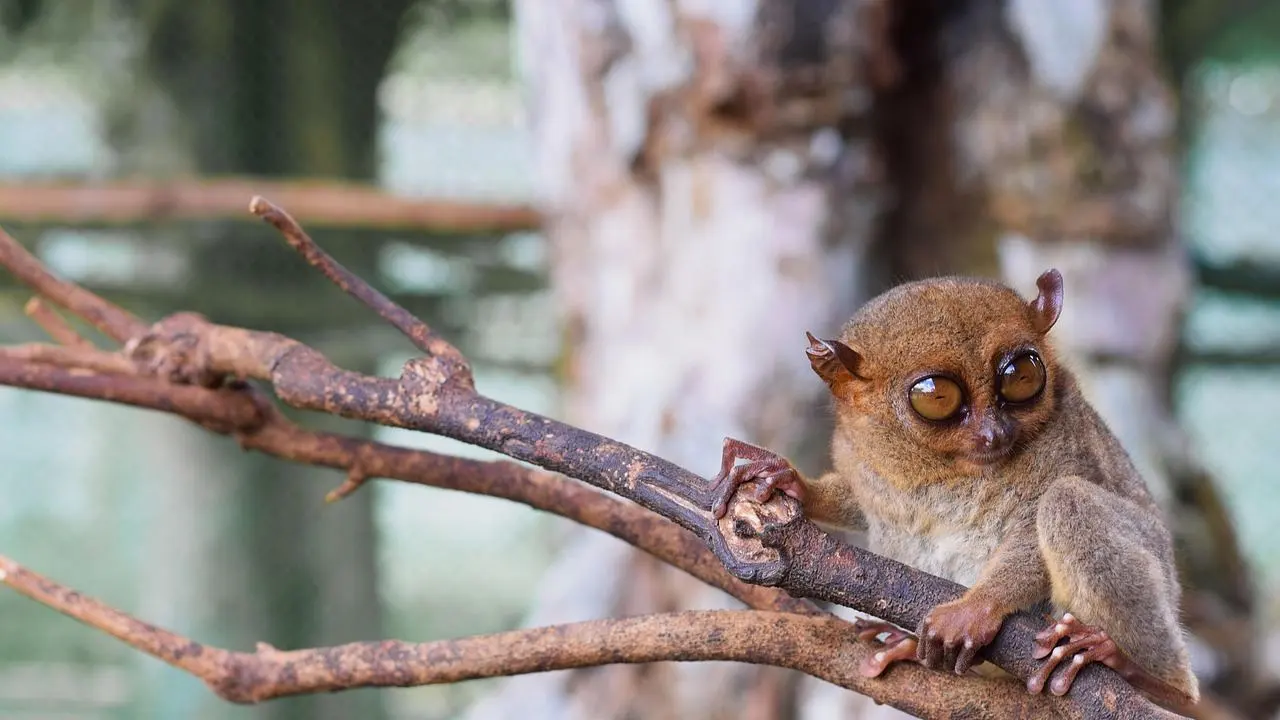
The Philippine tarsier (Carlito syrichta) is a tiny, nocturnal primate found only in the Philippines, including on Bohol. It is currently listed as Near Threatened on the IUCN Red List, and it does badly when handled or photographed with flash.
This species guide covers its biology, its legal protection and the habits that make it so vulnerable. Trip logistics sit in the philippines travel tips guide for first-time visitors.
Where the Philippine tarsier lives
The Philippine tarsier is endemic to the Philippine archipelago, and established populations are present primarily on the islands of Bohol, Samar, Leyte and Mindanao. It has also been recorded on smaller islands such as Maripipi, Siargao, Basilan and Dinagat. The species belongs to the family Tarsiidae, a lineage described as approximately 45-million-year-old, and the family name comes from the elongated tarsus, or ankle bone, that gives every tarsier its spring.
Its habitat ranges across second-growth forest, secondary forest and primary forest from sea level to 700 m. It favours dense, low vegetation, with perches close to the ground, and tall grasses, bushes and bamboo give it cover. Visayan speakers know it locally as mawumag in Cebuano and other Visayan languages.
Until a 2010 taxonomic revision by Shekelle and Groves, all living tarsiers sat in a single genus. That revision placed this species in its own genus, Carlito, named after the Filipino conservationist Carlito Pizarras. The tarsier on Bohol is treated as the subspecies fraterculus, although the IUCN taxonomic note describes the subspecies as poorly defined, so the species is treated as a whole.
Body, eyes and senses
The Philippine tarsier measures 85 to 160 mm in height, which makes it one of the smallest primates, and the average adult is about the size of a human fist. Males weigh 80 to 160 g, and females are usually lighter. The tail is narrow, bald apart from a tuft at the tip, and roughly twice the length of the body. The fur is thin and rough, ranging from gray to dark brown.
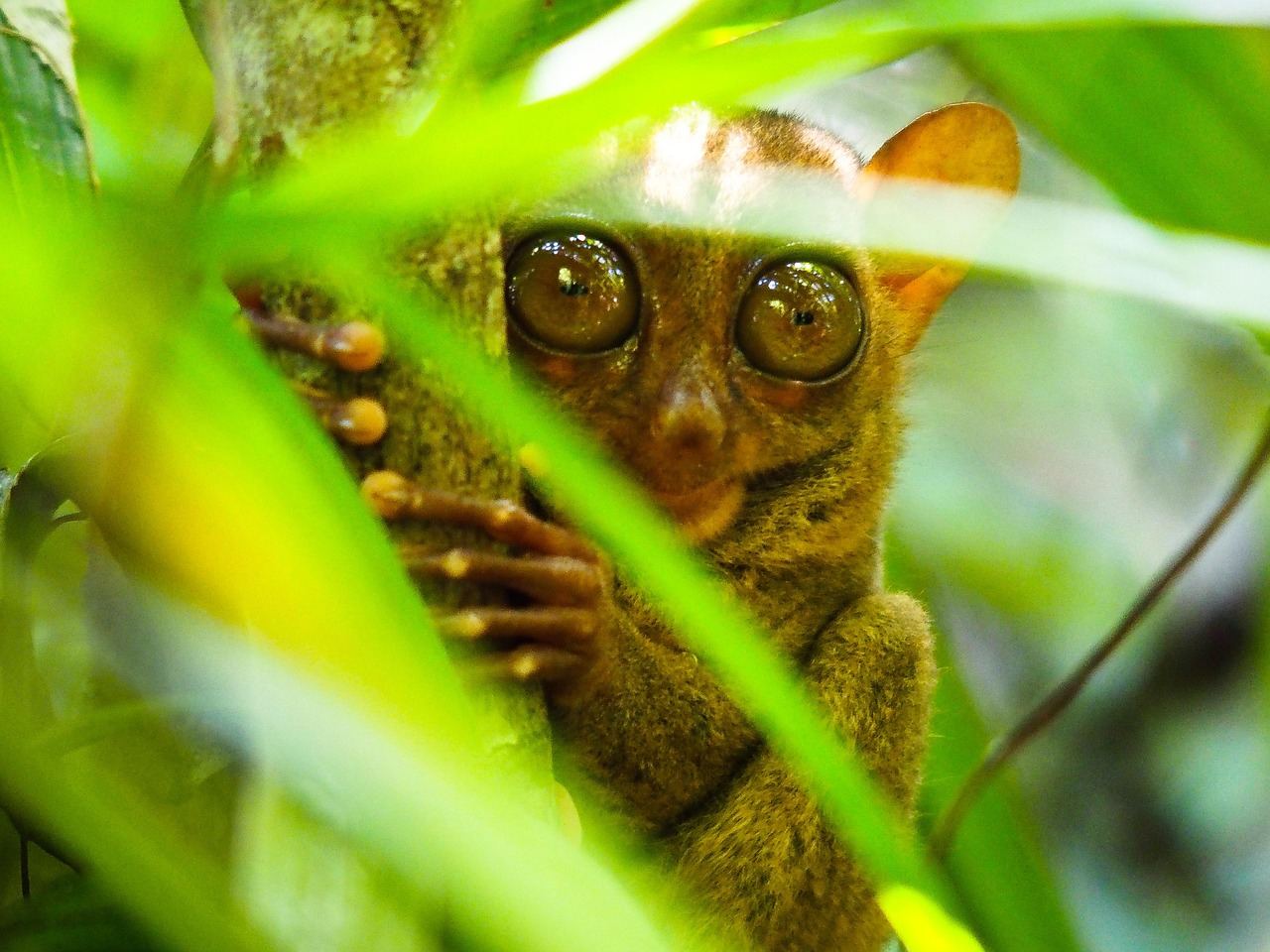
The eyes are the defining feature. Like all tarsiers, the Philippine tarsier’s eyes are fixed in the skull and cannot move in their sockets, so a special adaptation in the neck lets the round head rotate 180°. Its eyes are disproportionately large and give the animal excellent night vision. The large, membranous ears are mobile and almost constantly moving, which lets the animal track the slightest sound.
| Trait | Detail |
|---|---|
| Height | 85 to 160 mm |
| Weight (males) | 80 to 160 g |
| Head rotation | 180° |
| Elevation range | Sea level to 700 m |
| Conservation status | Near Threatened (IUCN) |
Measurements and range in the table follow the species entry on Wikipedia, and the status line matches its IUCN Red List infobox.
Long, pad-tipped digits let the tarsier cling to almost any surface, and the long ankle bones power leaps of at least 3 m from tree to tree. Its hearing is unusual as well: the species can vocalise in an ultrasound range of 70 kHz, and it uses a piercing single-note call and a softer, bird-like twill in everyday communication.
Diet, behaviour and breeding
The Philippine tarsier is primarily insectivorous. Its diet consists of insects, spiders, small crustaceans, and small vertebrates such as small lizards and birds, and it prefers live prey such as crickets and grasshoppers. After seizing prey, it carries the food to its mouth with both hands.
It is a shy, solitary animal that leads a mostly hidden life. During the day it sleeps in dark hollows close to the ground, near tree trunks and shrubs deep in dense bush. It becomes active only at night, clinging vertically to trunks and leaping from branch to branch. Research on home ranges found that males averaged 6.45 ha and females 2.45 ha, and individuals travel up to 1.5 km across the forest, although the animals mostly keep to themselves and only occasionally cross paths.
Breeding is slow. Gestation lasts about six months, and the female gives birth to one offspring per gestation. The infant is born with hair and its eyes open, and the mother carries it in her mouth. Newborns can already cling to branches, and within a month they can begin to leap. A tarsier is sexually mature after two years of age, which means a lost adult takes a long time to replace.
Besides human hunters, feral cats banished from nearby communities are the species’ main predators, and because of its nocturnal and arboreal habits it is also most likely to fall prey to owls or small carnivores in the canopy.
Conservation status and legal protection
The Philippine tarsier is currently listed as Near Threatened on the IUCN Red List, with habitat loss and poaching for the pet trade cited as the drivers. It is also listed in Appendix II of CITES, which controls international trade in the species.
Philippine law protects the animal directly. Proclamation No. 1030 was signed on June 23, 1997, declaring the Philippine tarsier a Specially Protected Faunal Species of the Philippines. In the text of the proclamation, the hunting, killing, wounding, taking away or possession of the Philippine tarsier and the conduct of activities destructive of its habitats are prohibited. The only exception is possession for educational, scientific or conservation-centred research, which needs certification from the DENR Secretary.
The DENR had already declared the tarsier a protected species through Administrative Order 38, and a wider wildlife law followed: the Wildlife Resources Conservation and Protection Act was enacted on July 30, 2001, and it names the tarsier as a flagship species.
Threats on Bohol and beyond
On Bohol, the Philippine tarsier was a common sight in the southern part of the island until the 1960s. Forest conversion to farmland, housing and roads has shrunk the secluded habitat the animal needs, and indiscriminate and illegal logging, cutting of trees for firewood and slash-and-burn farming have added to the loss.
Captivity is the other major danger. The species does poorly outside the wild because it feeds on live insects, and the lighting usually used in captivity can cause long-lasting damage to its eyes. Many activities associated with captivity (such as camera flashes, being touched, and being kept in an enclosure) stress the animal, and that stress can lead a tarsier to injure itself. The field supervisor of the Philippine Tarsier Foundation has also described how frequent handling leaves a tarsier under such stress that it can stiffen and stop breathing, according to a Philstar feature.
Tourism can make this worse. Private displays by people in Loboc, Bohol tend to diminish the lives of tarsiers, and the display of captive tarsiers might encourage tourists to acquire them illegally as pets. Demand for close contact is therefore part of the problem, not a neutral side effect.
Seeing tarsiers without harming them
The Philippine Tarsier Foundation was established in 1996 to conserve, promote research, and establish a sanctuary for the species, and it runs a sanctuary in Corella, Bohol. Visitors there can only go to a spot where the animals can be seen but not touched, according to Philstar. That rule is the standard to apply anywhere: no touching, no handling, no holding for photographs, and no camera flash.
A few practical principles follow from the biology.
- Choose a forest sanctuary where the animals roam free over a roadside enclosure or a venue that passes tarsiers around.
- Keep every camera flash switched off, and do not use torches or phone lights aimed at the animal, because the eyes are built for darkness.
- Stay quiet and keep distance. A tarsier asleep in a hollow during the day is resting and should not be disturbed.
- Never buy or accept a tarsier as a pet. Possession is prohibited under the national proclamation.
The forests where tarsiers live are on rural roads, and weather affects getting around, so the philippines typhoon season guide is worth reading before fixing dates. Sanctuaries and guides set their own rates and hours, so check them directly, and the money guide explains how the Philippine peso, ATMs and cards work for travellers.
This site is an independent travel guide. It is not the Bohol Provincial Government, the Department of Tourism, a sanctuary or a tour operator, and it takes no bookings.
Frequently asked questions
Is the Philippine tarsier endangered?
The species is currently listed as Near Threatened on the IUCN Red List. It is also protected under Philippine law, and CITES Appendix II covers it.
How big is a Philippine tarsier?
It measures 85 to 160 mm in height, and males weigh 80 to 160 g, which makes it one of the smallest primates.
Can visitors touch or hold a tarsier?
No. Handling stresses the animal, and the Philippine tarsier is a specially protected species, so possession is prohibited. Responsible sanctuaries let visitors see the animals from a spot where they cannot be touched.
Why is flash photography harmful?
Camera flashes are listed among the captivity-related activities that stress tarsiers. Their huge eyes are adapted to darkness, so flash is best left off entirely.
What does a tarsier eat?
Its diet consists of insects, spiders, small crustaceans and small vertebrates such as small lizards and birds. It prefers live prey.