Baclayon Church is the coral-stone parish church of the Immaculate Conception in the town of Baclayon, Bohol, and one of the oldest churches in the Philippines.
This guide covers its Jesuit origins, its architecture and furnishings, its heritage status, the earthquake that damaged it and the museum beside it. For the wider island, the guide to bohol tourism covers regions, transport and attractions.
How Baclayon grew from a Jesuit mission into a parish
The Bohol Provincial Tourism Office describes Baclayon as the first municipality established in Bohol by the Spaniards. The same page explains that the old name was Bacayan, because travellers used to detour, or bacay, around a rocky cliff along the shore.
The founding date depends on the source. The tourism office page gives 1595 as the year the Jesuit priests Juan de Torres and Gabriel Sánchez founded the town, and dates the church itself to 1596 on the same page. The encyclopaedia entry on Baclayon Church also gives 1596 for the founding of Baclayon and records that the first Jesuits came to the town on November 17, 1596.
Claims about age vary in strength. The tourism office page says the stone church built by the two priests is now considered the oldest stone church in the country, while the University of Santo Tomas describes the building more cautiously as one of the oldest churches in the country. That cautious phrasing is the safer way to describe it, and it is the wording this guide uses.
The mission grew into a parish church over the following century. According to the same encyclopaedia entry, Baclayon was elevated to a parish in 1717 and the present coral stone church was completed in 1727. When the Jesuits were expelled in 1768, the Augustinian Recollects succeeded them and heavily renovated the church. The entry adds that the building was saved from destruction during the Philippine–American War in exchange for food and water in 1901.
Spanish contact with Bohol had begun earlier. The tourism office dates the Sandugo, the friendship ritual between Miguel López de Legazpi and the Boholano chieftain Datu Sikatuna, to March 16, 1565. Anyone tracing the island’s colonial story can pair this church with the blood compact shrine in Tagbilaran, which marks that first pact.
Coral stone, a cross-shaped plan and a church facing the sea
The building is made of coral stone. The encyclopaedia entry describes a cross-shaped plan, with the crossing of nave and transepts surmounted by a pyramidal wall. It also notes that the church complex is strategically located facing the sea, which fits a town whose name comes from a shoreline landmark.
Later hands changed the exterior. The original tiled roof was replaced by galvanized iron in 1893, and the portico in front of the façade was added in 1875 as an extension by the Augustinian Recollects, as recorded in the encyclopaedia entry. A path of glazed blue tiles links the portico to the original façade, which the entry describes as simply designed.
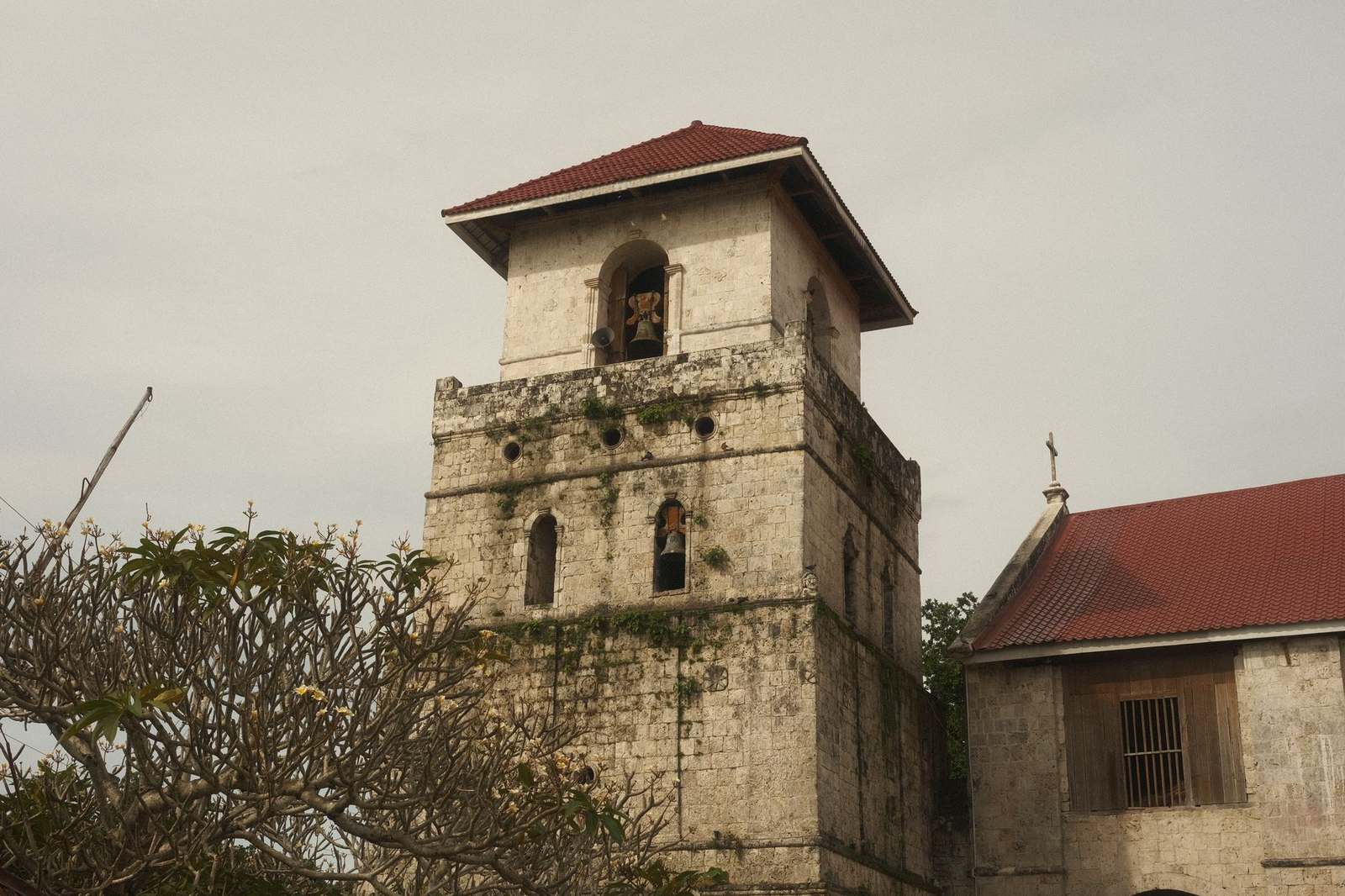
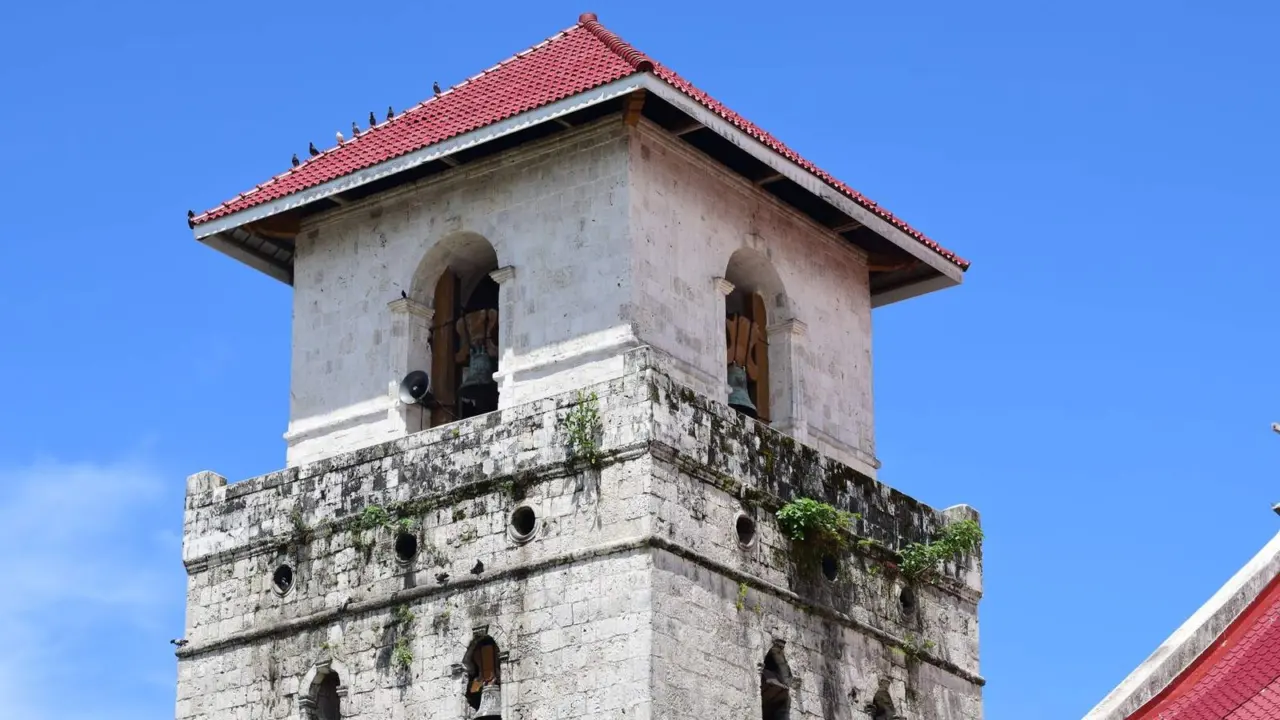
The bell tower tells its own story. The Jesuits left the quadrangular watchtower unfinished, and the Augustinian Recollects completed it, according to the same entry. A bas-relief of Saint Andrew carries an inscription giving the completion date as May 20, 1777.
Inside the church: altars, organ and baptistry
The interior has three retablos, or altarpieces: a central retablo mayor and two side altars, per the encyclopaedia entry. The central one is inscribed with the Jesuit motto Ad maiorem Dei gloriam, which suggests the Society of Jesus may have commissioned the altar. A silver tabernacle was added to it in 1810.
Above the entrance, the extended choir loft hides much of the original façade and houses a pipe organ dated 1824, based on the same source. The octagonal baptistry beside the gospel transept was constructed in 1853. A separate rectangular mortuary chapel, the ermita de difuntos, was built in 1859 near the baptistry, and a road leads from it to the cemetery.
The convent, the museum and the broas bakery
Beside the church stands the old convent. The encyclopaedia entry describes it as a typical bahay na bato, with a ground floor of coral stone and egg white mixed with plaster as binder, and an upper floor of light materials such as bamboo. Behind it, the same entry mentions a bakery that processes the egg yolk left over from that building method into broas, the sponge-finger biscuit. The treat is a small piece of the wider range of bohol delicacies that visitors can sample across the island.
Part of the convent now serves as a museum. The Bohol Provincial Tourism Office says the museum houses various religious artifacts and other historical items that showcase the culture and history of the town. The University of Santo Tomas reports that the Museo Parroquial de Baclayon, the Tagbilaran Diocesan Museum of Liturgical Arts, officially reopened on October 14, 2022 after redevelopment. Its displays present pieces from the parish collection against the backdrop of the liturgical seasons, so that objects are shown in the context in which they were used.
Heritage status and the UNESCO tentative list
Baclayon Church carries several national designations. The National Museum of the Philippines declared it a National Cultural Treasure in 2010, and the National Historical Institute, now the National Historical Commission of the Philippines, declared it a National Historical Landmark on July 27, 1994, as listed in the encyclopaedia entry.
The church also appeared on the Philippines’ UNESCO World Heritage Tentative List. A GMA News report from 2018 states that it was included in 1993. The encyclopaedia entry describes the listing as former and as part of a collective group called the Jesuit Churches of the Philippines. A tentative listing is only a preliminary step and does not make a place a World Heritage Site.
The 2013 earthquake and the 2018 reopening
The church was among those badly hit when a magnitude 7.2 earthquake struck Bohol. GMA News dates the quake to October 15, 2013 and lists the Church of San Pedro in Loboc and the Church of Our Lady of the Assumption in Dauis among the other damaged churches. The encyclopaedia entry says the portico and bell tower collapsed.
The rebuilding took years. The tourism office credits the efforts of the provincial government and the National Historical Commission of the Philippines. The church reopened on February 27, 2018, and GMA News reports that turnover rites handed it to the Diocese of Tagbilaran, with the Papal Nuncio to the Philippines present at the ceremony, in a February 2018 report.
Visiting Baclayon and what lies nearby
Baclayon is a coastal municipality close to the provincial capital. PhilAtlas puts the town centre about 6.52 kilometers from Tagbilaran in a straight line, and records a 2020 census population of 22,461 for the municipality. That makes it an easy add-on to a day around Tagbilaran, Dauis and the countryside churches.
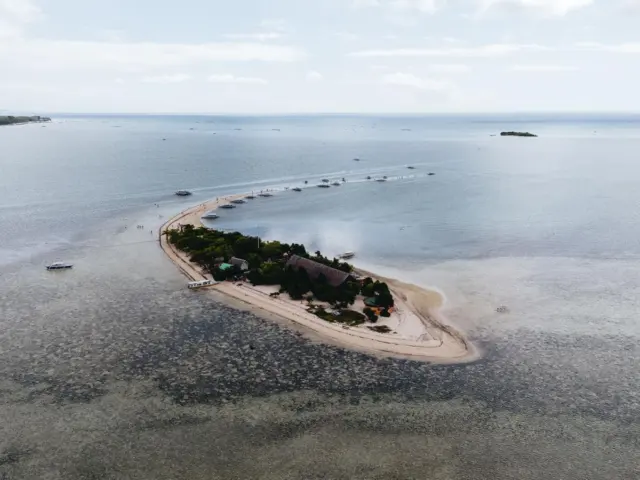
The tourism office also points to Pamilacan Island, which lies just off the coast of Baclayon and is known for snorkelling, diving and boat trips to spot marine life. Anyone joining a dolphin or whale watching boat should follow the operator’s published rules on distance and keep clear of touching or feeding wildlife.
This page is an independent travel guide. It is not run by the parish, the Diocese of Tagbilaran or any tourism office, and it takes no bookings. Opening hours, Mass times and any museum entrance fee are set locally and change, so none are listed here.
Frequently asked questions
When was the present stone church finished?
The Jesuit-era building took its present form in 1727, after Baclayon had been made a parish in 1717.
Did the Bohol earthquake destroy the church?
The quake caused major damage, including a collapsed portico and bell tower, and the building reopened to the public on February 27, 2018.
Is Baclayon Church a national heritage site?
Yes. It holds both a National Cultural Treasure declaration, made by the National Museum in 2010, and a National Historical Landmark declaration.
What is in the museum next to the church?
The Museo Parroquial de Baclayon holds liturgical art and parish objects, and its redevelopment was completed with a reopening on October 14, 2022.
How far is Baclayon from Tagbilaran?
The straight-line gap between the two town centres is 6.52 kilometers, according to PhilAtlas.